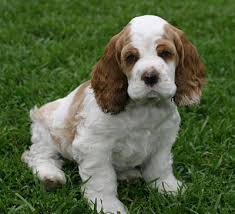
The Cocker Spaniel is a medium sized, sturdy dog. The
head is rounded with a pronounced stop. The muzzle is broad and deep
with square, even jaws. The teeth meet in a scissors bite. The eyeballs
are dark, very round with slight almond shaped eye rims. Merle Cocker
Spaniels can have blue eyes. The long, low-set ears are well feathered.
The topline slopes slightly from the front of the dog to the back and
the legs are straight. The tail is docked. Note: docking tails is
illegal in most parts of Europe. The dewclaws may be removed. The silky
coat is flat or slightly wavy. The hairs are medium length on the body
but short and fine on the head. There is feathering on the ears, chest,
abdomen and legs. The coat comes in any solid color, black with tan
points, merle, solid color with tan points and parti-color. Examples of
parti color combinations are white with buff or red, white with black,
or white with black and tan points. Field lines have shorter coats than
show lines.
 Height, Weight:-
Height: Males 15 ½ inches (38 cm) Females 14 ½ inches (36.8 cm)
Weight: 15 - 30 pounds (7 - 14 kg)
Health Problems:-
Some major concerns in American Cocker Spaniels
are cataracts, glaucoma and patellar luxation. Some minor concerns are
hip dysplasia, ectropion, entropion, PRA, allergies, cherry eye,
seborrhea, lip fold pyoderma, otitis externa, liver disease,
urolithiasis, prolapse of nictitans gland, CHF, phosphofructokinase
deficiency and cardiomyopathy. Occasionally seen are gastric torsion and
elbow dysplasia. Also IMHA (Immune Mediated Hemolytic Anemia).
According to a few owners:
"Our Cocker never had a sick day in her life
until she suddenly became lethargic and urinated blood. Six days later
and $3000 in vet bills, she died. I know you can't list every illness
due to space limitations, but the internal medicine specialist that
treated our dog said that IMHA is relatively common in Cockers, and
almost always fatal. It's a fast-acting, silent killer."
 Reported by Cocker Spaniel owner—"My American
Cocker Spaniel dog died on 9/26/2011 of IMHA. She was given
immunizations on 9/20 and showed first signs of a problem on 9/22. She
was 6 1/2 years old in good health. Please pass on that owners of
American Cockers need to be acutely aware of this disease and the
possibility of their dogs contracting it. They should always have a
blood test before immunization and at any sign of a problem afterwards
should immediately seek treatment from a vet. We knew nothing of the
disease and were never advised by the vet of the possibility in this
breed. We have since learned it is common and needs to be looked for in
this breed and age dog. Vets need to make sure owners are aware of it
and the possible relationship with vaccinations. I just want to help get
the word out."
Reported by Cocker Spaniel owner—"My American
Cocker Spaniel dog died on 9/26/2011 of IMHA. She was given
immunizations on 9/20 and showed first signs of a problem on 9/22. She
was 6 1/2 years old in good health. Please pass on that owners of
American Cockers need to be acutely aware of this disease and the
possibility of their dogs contracting it. They should always have a
blood test before immunization and at any sign of a problem afterwards
should immediately seek treatment from a vet. We knew nothing of the
disease and were never advised by the vet of the possibility in this
breed. We have since learned it is common and needs to be looked for in
this breed and age dog. Vets need to make sure owners are aware of it
and the possible relationship with vaccinations. I just want to help get
the word out."
"My dog also died of this disease (IMHA). He
was 7 1/2 years old. He showed no signs of being ill until two days
before he died. The disease works rapidly. At the first sign of becoming
ill the pet needs to be brought to the vet and will probably need a
blood transfusion. Our vet decided to wait and see in the morning, by
then it was too late. This disease does not always stem from vaccines;
my dog was not due for shots for another two months.”
Living Conditions:-
 Cockers will do okay in an
apartment if they are adequately exercised. They are fairly active
indoors. A small yard is sufficient. Not suited to live outside alone in
a kennel.
Cockers will do okay in an
apartment if they are adequately exercised. They are fairly active
indoors. A small yard is sufficient. Not suited to live outside alone in
a kennel.
Exercise:-
American Cockers have plenty of stamina and need regular exercise. They should be taken on
daily, long walks.
When walking, avoid brushy thickets that can tangle the coat. Be sure
to have the dog heeling beside or behind the person holding the lead, as
in a dog's mind the leader leads the way, and that leader needs to be
the human, not the dog.
 The Bullmastiff is massive, very powerfully built,
but is not a cumbersome dog. The large, broad skull is wrinkled and the
muzzle is broad, deep and usually darker in color. The forehead is flat
and the stop is moderate. The black nose is wide and has large nostrils.
The teeth meet in a level or undershot bite. The medium sized eyes are
dark hazel. The V-shaped ears are set high and wide, carried close to
the cheeks, giving a square appearance to the skull. The strong tail is
set high, thicker at the root and tapering and is either straight or
curved, and reaches to the hocks. The back is short, straight and level
between the withers and the loin. The short, dense, slightly rough coat
comes in brindle, fawn, or red, often with black markings on the head.
The Bullmastiff is massive, very powerfully built,
but is not a cumbersome dog. The large, broad skull is wrinkled and the
muzzle is broad, deep and usually darker in color. The forehead is flat
and the stop is moderate. The black nose is wide and has large nostrils.
The teeth meet in a level or undershot bite. The medium sized eyes are
dark hazel. The V-shaped ears are set high and wide, carried close to
the cheeks, giving a square appearance to the skull. The strong tail is
set high, thicker at the root and tapering and is either straight or
curved, and reaches to the hocks. The back is short, straight and level
between the withers and the loin. The short, dense, slightly rough coat
comes in brindle, fawn, or red, often with black markings on the head. Living Conditions:-

